30 November 2010

FILM NOIR FEMME FATALE


“I want to report a murder”

“Who was murdered?”

…

“I was”

[D.O.A (1950)]

As a point of interest - what does a woman’s appeal mean to you? Is it the promise of adventure, mystery and painful desire. Or is it the promise of mutual commitment, beyond a quick thrill?

The soft smell of infatuating perfume, blond tresses contrasted with unlit bars, and faint traces of liquor and tobacco; or fresh perms and the smell of a home cooked meal?

Without a doubt, the women in film noir play a central and recurring theme in the genre. Perhaps as a statement of the obsessions that move a man: money, liquor and women. The femme fatale (“ or the deadly woman”) is an ancient and popular character in western (and indeed world) texts. Generally, the femme fatale is shown to be a woman who exploits the weaknesses of men to her own advantage. Perhaps the interpretation that the construction of the femme fatale is ultimately a product of a patriarchal and largely inequitable society is itself an outdated interpretation. The femme fatale has become a movement of fashion and interest in modern society, and is a symbol of class.


Film noir gives a very hypothetical finger to the belief that “a way to a man’s heart is through his stomach”. The attractions you can find in the cast of women are predictable, but their use varied. I described a very typical split of woman: the femme fatal and, you know, the exact opposite of a femme fatale. You can recognize the ‘femme fatale’ because they are usually characterized as mysterious, duplicitous, double-crossing, gorgeous, unloving, predatory, tough-sweet, unreliable, irresponsible, manipulative and desperate women. And on the other hand, you have the type you’d take home to your mother. I don’t think this dichotomy is lost in modern entertainment either.

What is the appeal? As Frank Bigelow’s experience shows – it’s the possibility for quick, dangerous and self-destructive fun with no consequences of commitment. A woman who is equally motivated by desire as a man. The prospect of being “trapped” or “caged in” is something that men run from all the time. Face it – commitment phobia is for most men a reality. Frank Bigelow shows this – and he spends a lot of time running from it. While wanting the company and closeness of a woman, he doesn’t really want the burdens of commitment. Thus, the femme fatale becomes the obvious choice. He is drawn to mysteriously beautiful women at bars, who are in themselves powerful characters. Always in control but swayed by the moment.

In Film Noir Crime, the role of the femme fatale is often wrapped up in a web of complex deceit. They play key positions that transcend the common understanding of a woman – she has power, and is controlling of those around her. There is something really attractive about a powerful woman in film noir , and their ability to craft murder or disguise it is unbelievable. No doubt, the genre gives you a reason not to trust certain dames. But there’s still something more in crime noir – it’s really the disarming aspect of beauty in a dark city. That though everything is shouting in your bones to stay away, you keep wandering deeper and deeper into the allure of a femme.

There is something to be said about destructive desire – and in many parts, it characterized the society of the 1940s and 1950s. Disenchantment and materiality raised consumerism in a post war society torn by war and looking to find meaning in death. Only that there is no meaning, and the mundane lifestyle of, for example, an accountant like Frank, may change and be drastically transformed, but in the end he finds only death. Soldiers, accountants and murderers are not different in this respect.

So the mark of a man is how he lived. And in facing death, there is insight into our lives.

Ironically, Frank’s desire was the very cause of the death of him. He went to San Francisco to get away from a girl he loved but felt trapped by, following his desire he ends up drinking poison. Market week in San Fran had the city full of lovely dames, and beneath the surface, the deadly femme fatale. And while hunting down his murderer he realizes that the thing he was running away from was the very thing he was looking for all this time. That is, his true love who was always by his side.

http://filmnoircity.com/femme-fatale

What is ' Film Noir'?


What is 'Noir'?

Excerpt from the book 'Film Noir' by Alain Silver and James Ursini

How did a cycle of the American cinema become one of the most influential movements in film history? During its classic period, which lasted from 1941 to 1958, noir films were derided by critics of the time. Lloyd Shearer, for example, writing a Sunday supplement piece for The New York Times (‘Crime Certainly Does Pay,` 5 August 1945) mocked the trends in ‘crime films` that were ‘homicidal,` ‘lusty` and filled with ‘gut-and-gore crime.` In fact the top echelon of the major studios – Paramount, Twentieth Century-Fox, MGM and Warner Bros. – usually relegated their ‘crime films` to B-units and released them on the bottom half of double bills. The other majors – RKO, Universal, United Artists and Columbia – along with poverty-row companies like Producers Releasing Corporation (PRC), pumped them out shamelessly. There were, of course, prestigious exceptions, Academy Award nominees like The Maltese Falcon (1941, Warner Bros.), Laura (1944, Twentieth Century-Fox) and Double Indemnity (1944, Paramount); but even mainstream honours did not save these films from widespread disparagement by the critical community. In fact Shearer`s main target in his article is Double Indemnity.

Still from 'Quai des brumes', (1938)
The French poetic realist films of the 1930s mixed romantic crime thrillers with fatalism in low-life, fog-shrouded settings. Here deserter Jean (Jean Gabin) tries to save Nelly (Michèle Morgan) from a life of crime.


On the set of 'Attack!' (1956)
Director Robert Aldrich holds a copy of 'Panorama du film noir', the first book about film noir.

Still from 'M' (1931)
Hans Beckert (Peter Lorre, right) leads Elsie Beckmann (Inge Landgut) to her death. He is the archetypal film killer, a mixture of guilt and innocence, who says at some point, "I always feel that somebody is following me... It is myself... Following me."

JOHN ALTON PAINTING WITH LIGHT


"Black and white are colours" John Alton


Few cinematographers have had as decisive an impact on the cinematic medium as John Alton. Best known for his highly stylized film noir classics T-Men, He Walked by Night, and The Big Combo, Alton earned a reputation during the 1940s and 1950s as one of Hollywood's consummate craftsmen through his visual signature of crisp shadows and sculpted beams of light. No less renowned for his virtuoso color cinematography and deft appropriation of widescreen and Technicolor, he earned an Academy Award in 1951 for his work on the musical An American in Paris. First published in 1949, and long out of print since then, Painting With Light remains one of the few truly canonical statements on the art of motion picture photography, an unrivalled historical document on the workings of the postwar, American cinema. In simple, non-technical language, Alton explains the job of the cinematographer and explores how lighting, camera techniques, and choice of locations determine the visual mood of film. Todd McCarthy's introduction, written especially for this edition, provides an overview of Alton's biography and career and explores the influence of his work on contemporary cinematography.


29 November 2010

The Cabinet of Dr. Caligari trailer

UNIT 2A ARCHITECTURAL FURNITURE

UNIT 2A ARCHITECTURAL FURNITURE


We will undertake a series of seminars and workshops towards meeting the assessment

requirements for this unit architectural furniture can include but is not limited to Sets, Devices and Installations.


"In the pursuit of your outcomes you will be asked to explore the design of space for film, the design of space in film and the design of space through film."


CONTEMPORARY CONTEXT


The possibilities of this concept of expanded cinema situated in a contemporary context of

spatial design¨ technology and film practice presents a significant realm for meaningful

activity. Film and moving image practice is experienced in a range of situations.

Technological developments mean that the traditional tools and techniques within film are

now spatialised within our environment.

Cameras are now ubiquitous and pervasive. CCTV and handheld devices mean that we are

watchers as well as watched. We record and we are recorded.


The traditional presentation format of the cinema– the screen is also ubiquitous and pervasive meaning that film and the moving image form a constant background to our everyday activities. Interior and exterior spaces become sets scenes for content creation as well as the site for the delivery and distribution of that content.


MY AREA OF INTEREST AND INITIAL IDEAS FOR THE PROPOSAL

(How I am going to address the objective of the project requirements.)


I have been watching a lot of films and documentaries about the history of cinematography, set design and film direction. I became interested in the old ways of making a film.


"The Life and Work of Jack Cardiff" a film by Craig McCall

"The Andrei Tarkovsky Companion" film in the series of Artificial Eye

"Metropolis" Fritz Lang

"Solaris" Andrei Tarkovsky

"The Cabinet of Dr. Caligari" Wienne

"Woman in Moon" Fritz Land

"Black Narcissus" Michael Powell

"Man with the Movie Camera" D. Vertov


I looked at technological achievements and available tools in cinema, editing and motion image.


I have been READING, READING AND READING... Some of the books I really enjoyed and learned a lot:


"Solaris" Stanislaw Lem

"The invisible art" by Mark Cotta Vaz

"Film Architecture from Metropolis to Blade Runner" Dietrich Neumann

"Designing Dreams" Donald Albrecht

"How to read a film, Movies, Media and Multimedia" James Monaco

"Film Art, An Introduction" McGraw Hill


DOCUMENTING

(I have been recording different events and situation in order to experience and capture the world through the lens. I have discovered a whole new way of looking at space, objects and people. I have been able to notice many details I wasn't aware of before.


I am interested in the EXPLORATION of the contrast between the popular dreams realized in set designs of film architects and the Utopian visions expressed in the drawings of modern architects.


PROJECTING THE DREAM ARCHITECTURE (SETS)

EXPRESSING THROUGH PRINTED WORD ( use of the silent movie scripts)

PHOTOGRAPHIC IMAGE

EDITING


THINGS/ TECHNIQUES TO CONSIDER


Various technological and artistic way of enhancing the film and image:

Jack Cardiff - painting on lenses, celluloid film

Len Lye - short motion image films,celluloid scraching

Matte Painting

Shadow Photography/ Phonogram

Design of the movie set ( Kubric, Fredric Lans)

Working with the new technology in editing and motion image (Final Cut Pro Studio).


DVD Studio Pro Tutorial: Power Learning Series Part 1-Burning a Basic DVD

Final Cut Pro Sin City Effect

South Bank Project Update: Week 5


MEDIA SKILLS
Video Editing and working with Motion Images

FINAL CUT STUDIO EXPLAINED


After the 3 Day Film Workshop at the triangle I returned to working on my project.

So what have I been up to...

I decided to upgrade on my Media Skills, so I got some new software for Video Editing and working with Motion Images.

FINAL CUT or ADOBE PREMIERE PRO? Which is the right way to go...

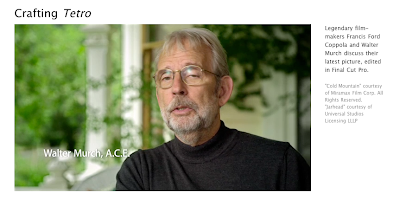
Legendary film­makers Francis Ford Coppola and Walter Murch discuss their latest picture, edited in Final Cut Pro.(click here to watch the documentary)


The Coen brothers discuss the importance of color grading in creating the distinctive look of their films. (Watch now)


I have been using Adobe Premiere Pro in the past, so this time I have chosen Final Cut Pro and I fell in love with the software immediately (Final Cut Pro Studio get it here).


With all the advancements in Final Cut Pro 7, there are now even more reasons why it’s the first choice of professional editors. Powerful new features and time-saving improvements help you work faster than ever.
Final Cut Pro 7 gives you more creative options and technical control. Final Cut Pro 7 offers real-time performance for more than 150 filters and effects as well as for multistream video.


Here are the links to my favourite tutorials:
I am using the Adobe Premiere Pro Cs5 and Final Cut Pro7, Adobe After Effects Cs5, Motion 4


Click on the link above for the tutorial, that will not only get you started but teach you how to be good and creative with Final Cut Pro 7. In this Apple Final Cut Pro 7 Training Video, accomplished author and trainer Andy Anderson takes you through the ins and outs of the worlds most popular video editing software,Final Cut Pro 7. Over 7.5 hours long, and with 164 training videos. In this video tutorial Andy Anderson breaks down the complexity of this powerful editing tool into simple, bite sized pieces that anyone can learn from. Covering the basics of FCP right from organizing your projects and importing clips and media, to assembling, editing and finally exporting your finished product, Andy makes sure that you are fully able to understand and use Final Cut Pro 7. Included with this amazing tutorial video DVD for Final Cut Pro 7 is over 3.5 GB of work files on DVD, so you can work along with Andy, and practice on the exact clips and with the exact media that you will find in this training DVD. By the end of this Apple Final Cut Pro 7 Tutorial video, you will be fully capable of creating and editing your simple or complex projects in Apple Final Cut Pro 7.

MOTION 4 (3D effects in record time) THIS IS THE PLACE WHERE THE MAGIC HAPPENS!

Motion 4 allows you to animate in real time — and even make changes during playback. Press a key or slide a fader. Drag a behavior, then drag another one on top of it. Work quickly and fluidly. If you want, you can fine-tune your animations with precise keyframe curve editing.Just drag and drop to send particles exploding through space. Swing cameras around an object with breathtaking ease. Apply new, realistic shadows and reflections with a click, and animate credit rolls in seconds. With Motion 4, it’s easier than ever to create astonishing 2D and 3D motion graphics. Add drama to any scene by animating ambient, directional, point, and spot lights, with control over light intensity, falloff, color, and more.

3D SHADOWS

ADDING SHADOWS and REFLECTIONS (click here to watch now)

Motion 4 makes it easy to add dramatic shadows that animate dynamically with the movement of objects and lights. When you set up a point or spot light, a single click lets you designate it as a shadow-casting light. Then Motion adjusts the shadow as you position objects, lights, or the camera. Refine the look of any shadow by adjusting edge softness and shadow colour.


COLOUR 1.5

Progress made beautiful.

Color 1.5 puts the power of high-end grading in your hands. Thanks to intuitive tools and deeper round-trip integration with Final Cut Pro, you can quickly improve a single scene or create a signature look for an entire sequence. Now with native workflows in high-quality formats up to 4K, Color is the ultimate finishing tool for music videos, commercials, broadcast post, and feature films.

DVD STUDIO PRO 4


Simply powerful DVD authoring.

Extend your creative vision to every aspect of DVD authoring. DVD Studio Pro 4 makes it easy, with intuitive authoring tools and a comprehensive set of advanced features for navigation, playback, and mastering.

COMPRESSOR


Streamlined encoding and delivery

Compressor 3.5 makes encoding easy and efficient, whether you’re outputting a single file or delivering multiple files in multiple formats. With enhanced droplets and new batch templates, Compressor offers you even more ways to save time